
Introduction
In the modern corporate landscape, ‘busyness’ is often mistaken for productivity. Most administrative departments are drowning in a sea of repetitive emails, manual data entry, and fragmented scheduling. This isn’t just a workflow issue—it’s an economic drain. At Piscartsynergy, we believe that the soul of an organization should be focused on strategy, not paperwork.
As we’ve discussed in our guides on High-Performance AI Hardware and Data Analytics Secrets, the tools for a revolution are already on your desk. The challenge is the ‘Implementation Gap.’
In this comprehensive guide, we provide a step-by-step practical manual for integrating AI into smart administration. We are moving beyond theory to solve the real-world problems of workplace friction. This is your essential blueprint for transforming your office into a high-efficiency powerhouse
Quick Summary: To achieve massive workplace efficiency with AI in 2026, start by automating administrative tasks using AI agents for scheduling, email filtering, and data entry. These smart practices allow teams to focus on high-value strategic growth.
Solving the ‘Meeting Black Hole’ with AI Transcription and Synthesis
The Problem: The average professional spends 31 hours a month in unproductive meetings. Information is lost, and action items are forgotten.
The AI Solution: Implementing an AI Meeting Assistant (like Otter.ai, Fireflies, or Microsoft Teams Premium).
Step-by-Step Practical Guide:
- The Integration: Connect your AI assistant to your professional calendar.
- The Meeting Phase: Let the AI record and transcribe in real-time. This allows every participant to focus 100% on the conversation rather than taking notes.
- The Synthesis: Post-meeting, use the AI to generate a ‘5-Point Executive Summary.’
- The Action: Distribute the summary and assigned tasks immediately.
Result: You reduce follow-up emails by 80% and ensure total accountability across the team.

Intelligent Inbox Management (e-mailing): The Death of the ‘Unread’ Pile
The Problem: Administrators spend up to 28% of their workday just managing emails. Most of these are low-value notifications or repetitive queries.
The AI Solution: Leveraging LLM-based email assistants and automated categorization.
Practical Implementation:
- Drafting with the Human Signature: Use AI to draft responses to standard inquiries. As we teach at Piscartsynergy, you must apply your ‘Human Signature’ to the final 10% to maintain professional warmth.
- Automated Sorting: Set up AI rules to prioritize emails based on urgency and sentiment. High-value client emails move to the top; internal newsletters are archived for later.
Pro Tip: For those using high-performance workstations, running local AI agents can process your emails securely without data leaving your company’s firewall.
Cognitive Document Processing(Data-Entry): Automating the Paper Trail
The Problem: Manual data entry from invoices, contracts, and receipts is slow and prone to human error.
The AI Solution: OCR (Optical Character Recognition) combined with AI reasoning.
Step-by-Step Practical Guide:
- Scan & Upload: Use tools like Rossum or Google Document AI to “read” your paperwork.
- Data Extraction: The AI identifies the “Total Due,” “Date,” and “Vendor” automatically.
- Validation: A human administrator does a 5-second check (Human-in-the-Loop).
- Auto-Sync: The data is pushed directly to your accounting software or Data Analytics dashboard.

Autonomous Resource Allocation: The End of Calendar Chaos
The Problem: The “back-and-forth” of finding a time that works for ten different executives can take days. Traditional scheduling tools are static and don’t understand the nuance of “priority.”
The AI Solution: Intelligent Scheduling Engines (like Clockwise or Reclaim.ai).
Step-by-Step Practical Guide:
- Establish Priorities: Define your high-value deep work hours in the AI settings.
- Contextual Scheduling: Unlike basic links, AI agents analyze the “weight” of a meeting. If an urgent client request comes in, the AI automatically shifts low-priority internal syncs to the next day.
- The “Buffer” Rule: Program the AI to insert “Decompression Buffers” (10-minute breaks) between meetings. This solves the workplace problem of back-to-back fatigue.
Workplace Benefit: You reclaim roughly 4 hours of administrative labor per week, per manager.
The Ethical HR Framework(Hiring & Training Bottleneck): Accelerating Talent Acquisition
The Problem: Screening hundreds of resumes for a single role leads to “Reviewer Fatigue,” where great candidates are often missed because they were at the bottom of the pile.
The AI Solution: Semantic Recruitment Filtering and Automated Onboarding.
Practical Implementation:
- Beyond Keywords: Use AI to look for skills and potential, not just matching words. This reduces the time-to-hire by 60%.
- The Human Signature in HR: At Piscartsynergy, we warn against total automation here. AI should be used to “shortlist,” but the human administrator must conduct the final cultural fit interview.
- Automated Training: Create an AI-powered “Knowledge Base.” Instead of a new hire asking the manager 50 questions, they ask the company’s private AI agent, which has “read” all your office manuals.

The Administrative Hardware: Powering the Smart Office
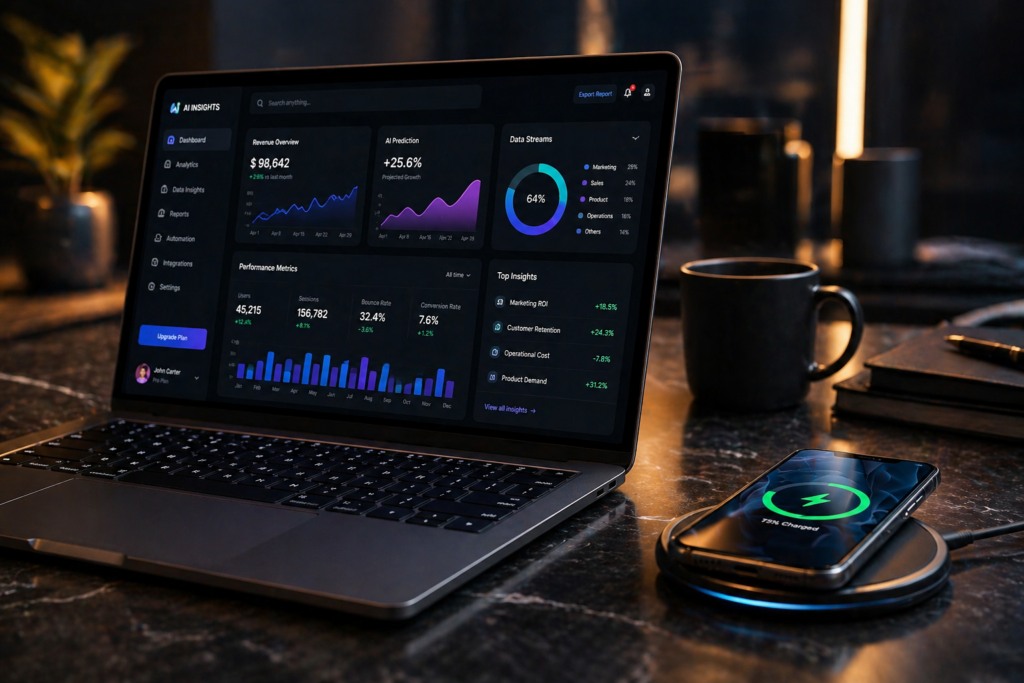
Smart administration is only as fast as the hardware it runs on. As we detailed in our Essential AI Laptop Guide, running multiple AI agents, transcription software, and data analytics dashboards simultaneously requires high-performance NPU (Neural Processing Unit) architecture.
To implement the ‘Smart Workplace’ blueprint, your administrative team needs workstations with a minimum of 16GB of RAM and dedicated AI processing power. Without this foundation, the ‘Smart Office’ will suffer from lag and technical friction.
The Administrative Prompt Library: Mastering the Human-AI Interface
One of the primary reasons workplace efficiency fails is poor communication with AI models. To achieve the 1,500% productivity gains we discuss at Piscartsynergy, administrators must move beyond basic requests. You must build a ‘Prompt Library.’
Practical Example: The Executive Summary Prompt
Instead of saying ‘summarize this meeting,’ use a structured prompt:
‘Act as a Senior Executive Assistant. Analyze the attached transcript. Extract 5 key decisions, 3 urgent action items with owners, and any mentions of budget or deadlines. Present this in a professional table format for the CEO.’
By standardizing these ‘Power Prompts’ across your office, you ensure that every department produces the same high-level quality. This is the difference between a disorganized office and a smart workstation.
Solving the ‘Information Archive’ with AI-Powered Internal Search
The Problem: Employees spend nearly 20% of their week just looking for internal information—contracts, policy updates, or previous project data.
The AI Solution: Knowledge Base Integration (RAG – Retrieval-Augmented Generation).
Step-by-Step Implementation:
- Centralize the Data: Move all office manuals, FAQs, and policy documents into a searchable cloud directory.
- Implement a Private AI Agent: Use tools like Custom GPTs (in a secure Enterprise environment) or local AI models.
- The ‘Ask the Office’ Interface: Employees simply type, ‘What is our policy on remote work for Abu Dhabi residents?’ The AI reads the 50-page manual and gives the answer in 2 seconds.
The Result: You eliminate ‘Interruptive Questions’ in the workplace, allowing managers to stay in a state of high-focus deep work.
Security and Sovereignty: Protecting Workplace Data in the AI Era
Efficiency must never come at the cost of security. For professional administrators in 2026, the ‘Privacy Problem’ is real. At Piscartsynergy, we advocate for a ‘Sovereign Data’ approach.
The Checklist for Secure Smart Practice:
- Zero-Data Retention: Ensure that the AI tools you use for meeting transcription or email drafting do not use your company’s private data to train their public models.
- Local Processing Power: As we detailed in our Workstation Hardware Guide, the safest way to handle sensitive administration is through local AI processing. High-performance laptops with dedicated NPUs can handle many AI tasks without ever connecting to the cloud.
- Human Oversight: Every AI-generated report or contract must undergo a ‘Human Signature’ review. This is not just for quality; it is for legal and ethical compliance.

The Metrics of Success: Measuring Your Efficiency Gains
You cannot manage what you do not measure. To prove the value of the Administrative Revolution, you must track key performance indicators (KPIs).
Workplace Metrics to Track:
- Labor Hours Reclaimed: The total time saved by automating scheduling and transcription.
- Response Latency: How much faster your team responds to client inquiries using AI drafting.
- Error Reduction: Comparing the accuracy of AI-driven document processing vs. manual entry.
By presenting these metrics to leadership, you transform administration from a ‘cost center’ into a ‘profit-driving’ engine of the business.
Practical Implementation Roadmap: Your Step-by-Step Transition
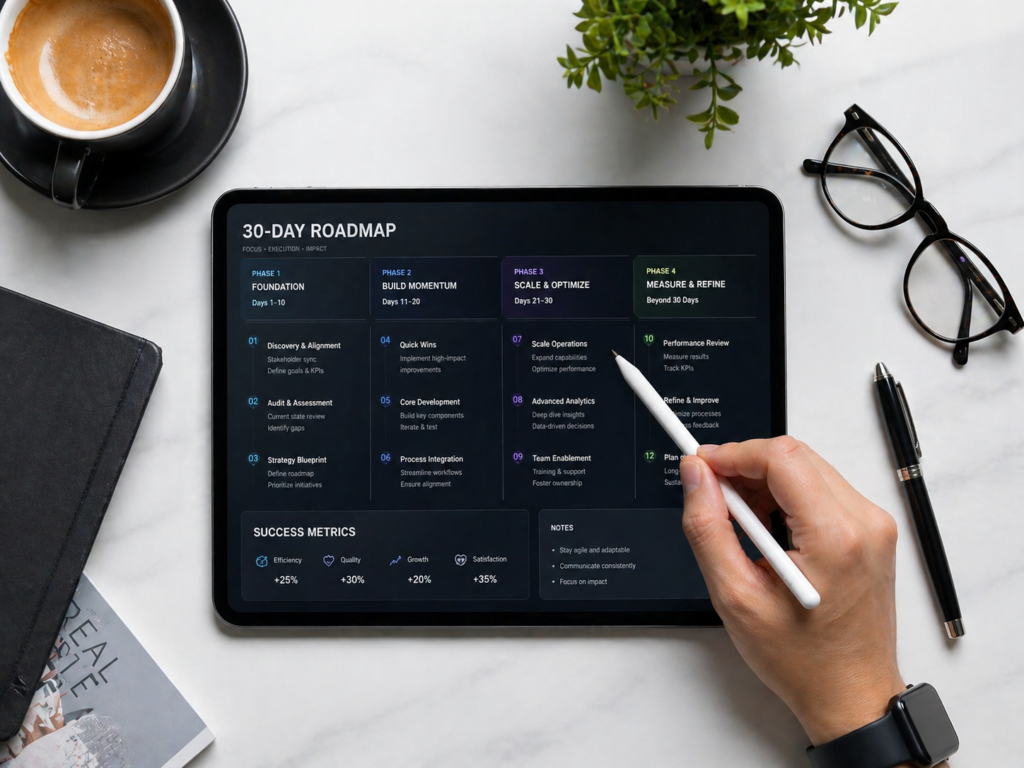
Theory without action is merely a distraction. To transform your workplace into a smart administrative hub, you must follow a structured implementation roadmap. At Piscartsynergy, we recommend a 30-day phased approach to ensure your team adapts without feeling overwhelmed by the technology.
Phase 1: The Audit (Days 1–7)
Identify the ‘Time-Thefts.’ Track your administrative tasks for one week and highlight any task that is repetitive, manual, or purely administrative. This becomes your ‘Automation Target List.’
Phase 2: The Pilot (Days 8–14)
Choose one tool to solve one specific problem. We recommend starting with AI Meeting Transcription. The immediate relief of not having to take manual notes provides the ‘quick win’ your team needs to trust the AI system.
Phase 3: The Integration (Days 15–21)
Link your tools together. Connect your transcription software to your task manager and your email assistant to your calendar. This is where the ‘Content Factory’ effect begins to happen, as data flows seamlessly between departments.
Phase 4: The Review (Days 22–30)
Analyze your ROI Metrics. Compare your workload from Phase 1 to Phase 4. You should see a reclaim of at least 15–20% of your operational hours. Use this data to justify expanding your AI Workstation hardware for the rest of the team.
The Milestone: Leading the Efficiency Revolution
The dynamic toward smart administration is more than a technical upgrade; it is a mindset shift. The professionals who thrive in 2026 will not be those who work the longest hours, but those who build the smartest systems that delivered efficiently.
By integrating these five secrets into your workplace, you are reclaiming the most valuable asset in business: Human Focus. When the machines handle the routine, you are free to lead, to innovate, and to scale.
The blueprint for massive workplace efficiency is now in your hands. Whether you are managing a small team in the UAE or a global enterprise, the time to start is now. Let this be the day you move from the ‘old way’ of manual friction to the new era of professional-grade intelligence. The revolution starts at your desk.

“AI enthusiast and Digital entrepreneur dedicated to helping others Leverage Technology for Financial Freedom”.
As an Amazon Associate, I earn from qualifying purchases.
`