
Introduction
When an organization transmits sensitive corporate assets, proprietary source code, or protected consumer information across external network boundaries to third-party AI endpoints, it effectively relinquishes absolute data sovereignty. This structural risk has forced forward-thinking IT departments, Chief Information Security Officers (CISOs), and data architects to reevaluate their technological infrastructure.
By transitioning toward locally hosted, on-premise Large Language Models, modern enterprises can successfully construct a secure computational perimeter. This operational model allows organizations to fully harness advanced semantic reasoning engines while maintaining strict, absolute data isolation. This comprehensive architectural manual examines the structural framework, security configurations, and deployment strategies required to execute local LLM pipelines optimized for enterprise data security in 2026.
The Structural Vulnerabilities of Public Cloud-Hosted AI Infrastructure
To accurately understand the imperative for localized machine learning environments, one must rigorously audit the implicit and explicit risks natively associated with public cloud-hosted alternative models. When utilizing standard software-as-a-service (SaaS) artificial intelligence platforms, proprietary data traverses multiple intermediate architectural layers, each presenting a distinct vector for potential exfiltration, compliance friction, or structural exposure
Data Ingestion and Telemetry Retention Policies
Public API vendors operate under dynamic service-level agreements that frequently authorize the retention of input prompts and context metadata for telemetry analysis, service optimization, or iterative model training. Even when contractual clauses allow for data-use opt-outs, the physical storage of enterprise intellectual property on external multi-tenant server infrastructure introduces systemic risk.
Multi-tenancy inherently implies that a single hyper-scaler software vulnerability, side-channel attack, or localized access control misconfiguration could expose isolated enterprise datasets to unauthorized concurrent tenants sharing the same physical silicon arrays
Man-in-the-Middle (MitM) and Cryptographic Interception
Although data in transit is fundamentally protected by transport layer security (TLS) frameworks, any data moving across public routing nodes remains theoretically vulnerable to sophisticated cryptographic interception, routing configuration manipulation, or infrastructure-level visibility. For highly regulated industries—such as sovereign defense networks, multinational financial entities, and advanced healthcare providers—the mere transit of raw, unencrypted semantic intellectual property across external internet pipelines violates core data minimization principles.
Dependency, Vendor Lock-in, and Arbitrary API Fluctuations
Relying entirely on external AI infrastructure subjects core enterprise operations to the commercial stability, pricing frameworks, and operational uptime of the parent vendor. Sudden deprecations of specific model weights, adjustments to structural alignment filtering, or unexpected platform downtime can instantly paralyze integrated business pipelines.
Furthermore, arbitrary backend updates can introduce semantic drift, altering how the model interprets corporate data without warning, thereby undermining systemic reliability.
Architectural Taxonomy of Local Enterprise LLM Frameworks
Building a resilient, high-performance on-premise AI ecosystem requires a calculated synthesis of specialized software compilation engines and modern hardware topologies. Unlike standard corporate database configurations, localized language models require immense parallel processing power and optimized memory bandwidth to manage real-time text token generation.
+---------------------------------------------------------------------------------+

|                         ENTERPRISE APP / USER INTERFACE                         |
+---------------------------------------------------------------------------------+

                                         |
                                         v  (Secure Local API / Vector Query)
+---------------------------------------------------------------------------------+
|                       ORCHESTRATION LAYER (LangChain / LlamaIndex)              |
+---------------------------------------------------------------------------------+

                         |                               |
                         v                               v
+------------------------------------+       +------------------------------------+

|   LOCAL INFERENCE ENGINE           |       |   LOCAL VECTOR DATABASE            |
|   (vLLM / Ollama / llama.cpp)      |       |   (Milvus / Qdrant / Pgvector)     |
+------------------------------------+       +------------------------------------+

                         |                               |
                         v                               v
+---------------------------------------------------------------------------------+

|                ISOLATED STORAGE & HARDWARE (NVIDIA H100/L40S / Apple Silicon)    |
+--------------------------------------------------------------------------------
The Inference Engine Layer
The inference engine serves as the core runtime environment that executes the quantized mathematical layers of the neural network. To ensure enterprise scalability, organizations must bypass unoptimized python environments and deploy high-throughput compilation runtimes:
- vLLM (Virtual Large Language Model): An open-source, ultra-high-speed runtime engine optimized for enterprise server configurations. By utilizing a proprietary technique known as PagedAttention, vLLM dynamically manages graphics processing unit (GPU) memory with zero fragmentation, allowing a single server stack to handle hundreds of concurrent user requests simultaneously.
- Ollama & Llama.cpp: Optimized runtimes designed to execute models compiled in the GGUF data format. These tools utilize advanced CPU/GPU tensor splitting, enabling enterprises to run highly capable open-weights models on cost-effective workstation hardware or distributed edge nodes without sacrificing baseline stability.
The Vector Storage and Retrieval Layer (RAG Architecture)
A local model is only as useful as the internal corporate knowledge it can safely access. To inject private company manuals, technical document archives, and customer database logs into the model without fine-tuning, organizations deploy a Retrieval-Augmented Generation (RAG) loop.
This requires an on-premise vector storage database (such as Milvus, Qdrant, or Pgvector) running inside the secure local network. The database translates corporate text files into mathematical numerical arrays (embeddings), matching the user’s prompt with exact relevant internal text files in real-time, completely isolated from the public web.
Comprehensive Hardware Matrix for Localized Deep Learning Environments
Successfully running highly complex, multi-billion parameter models locally requires picking hardware configurations based on explicit engineering requirements. The table below outlines standard deployment pathways for local corporate infrastructure:
| Deployment Tier | Optimal Model Selection | Required Hardware Architecture | Target Enterprise Workload |
|---|---|---|---|
| Enterprise Datacenter | Llama-3-70B (FP16), Mistral-Large | 2x to 4x NVIDIA H100 (80GB VRAM) or L40S Server Nodes | Multi-department operations, continuous RAG document parsing, and local model fine-tuning. |
| Regional Office Node | Llama-3-8B (Unquantized), Mistral-7B | 1x to 2x NVIDIA RTX 6000 Ada or RTX 4090 (24GB VRAM) | Local branch legal text analysis, localized code completion, and dedicated data auditing. |
| Secure Edge / Desktop | Llama-3-8B (Quantized GGUF Q4_K_M) | Apple Silicon Mac Studio (64GB-128GB Unified Memory) | Executive data review, air-gapped field research, and isolated forensic analysis |

Step-by-Step Security Hardening Protocol for Local LLM Deployments
Merely installing a model locally does not automatically guarantee absolute protection. If the server hosting the model is misconfigured, it can create internal lateral movement vulnerabilities within your corporate network. Organizations must execute a strict multi-layer security hardening protocol to lock down the infrastructure.
1. Air-Gapping and Perimeter Network Isolation (VLAN Tunnelling)
The server hosting the local LLM inference stack must be assigned to an entirely isolated Virtual Local Area Network (VLAN). Implement strict firewall rules at the switch level to ensure that the AI training and inference hardware possesses absolutely zero outbound routes to the public internet.
All communications moving into the AI container must be strictly funneled through a local reverse proxy server running within the private corporate intranet, using audited, encrypted endpoints
2. Strict API Authentication and Tokenization Frameworks
Never leave local inference engine endpoints (such as default Ollama or vLLM ports) wide open to the local network. Implement an intermediate authentication layer utilizing JSON Web Tokens (JWT) or secure OAuth2 authentication protocols.
Every individual internal software request heading toward the local model container must pass through an automated credential verification service to block unauthorized internal cross-department lateral access
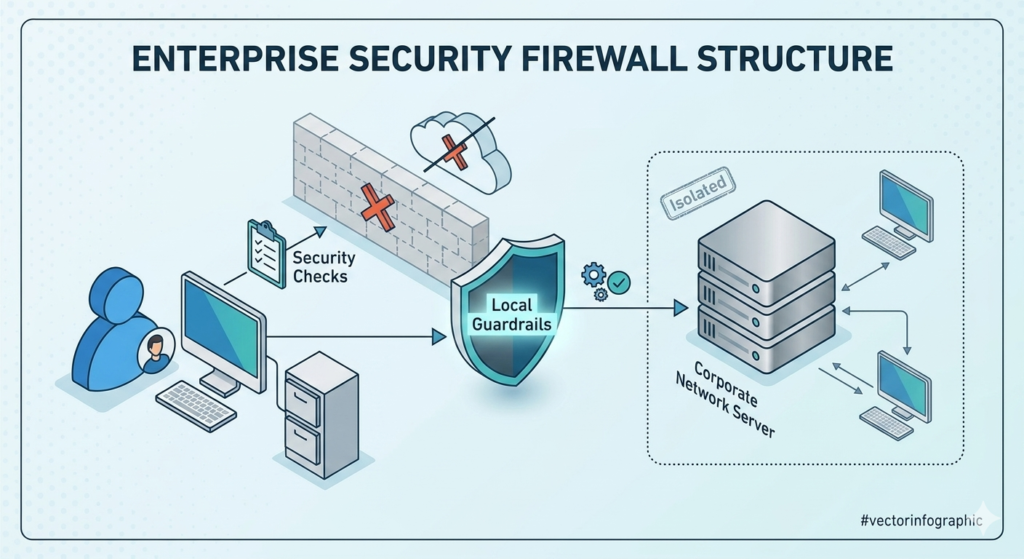
3. Rigorous Prompt Sanitization and Output Guardrails
Local models remain susceptible to semantic manipulation, adversarial prompt injections, and jailbreak attempts designed to leak internal system files. Deploy an open-source security guardrail framework—such as NeMo Guardrails or Llama Guard—directly in front of the local model’s input vector.
This security layer acts as an automated firewall that real-time scans incoming user queries for hostile injection code patterns and filters out unexpected model outputs before they reach employee workstation screens.
Quantization Engineering: Balancing Compute and Model Accuracy
One of the most profound breakthroughs in local language model deployment is the engineering practice of Quantization. By default, neural networks store their mathematical parameters (weights) as highly complex 16-bit or 32-bit floating-point numbers (FP16/FP32).
While incredibly precise, running an unquantized 70-billion parameter model requires hundreds of gigabytes of expensive enterprise VRAM, creating a massive cost barrier for local IT departments
Quantization systematically downscales these mathematical values into compact 4-bit, 5-bit, or 8-bit integers (e.g., INT4/INT8 formats). This compression drastically minimizes the model’s physical memory footprint.
For instance, a model that originally required 140GB of VRAM can be compressed via 4-bit quantization to fit entirely inside a single 40GB frame. This compression enables the model to run at hyper-fast token generation speeds on standard consumer or mid-tier enterprise hardware.
[Original FP16 Weight Matrix] ---> (Quantization Processing) ---> [Compressed INT4 Weight Matrix]
       (140GB VRAM Required)                                             (35GB VRAM Required)
                                                                 * maintains ~99% semantic accuracy
Extensive data science research proves that modern quantization algorithms—such as AWQ (Activation-aware Weight Quantization) and GPTQ—achieve this compression with near-zero loss in baseline semantic accuracy or contextual understanding.
By applying quantization engineering, enterprises can drastically reduce their initial capital hardware expenditures while successfully keeping their entire operational intelligence loop hosted completely on-premise.
Regulatory and Compliance Frameworks Satisfied by Local AI Deployments
For modern global enterprises, content data protection is not merely an operational preference; it is a rigid legal obligation. Moving to local open-weights deployments provides immediate compliance alignment across various complex global legislative frameworks:
HIPAA (Health Insurance Portability and Accountability Act): For medical entities processing protected health information (PHI), passing patient case data to cloud AI endpoints risks massive regulatory fines. Local LLM environments keep all patient records locked securely within verified on-premise data server structures
GDPR (General Data Protection Regulation): Under European data sovereignty mandates, citizen data must remain fully audit-traceable and protected against international data transfers. Local infrastructure guarantees that data storage and processing actions happen entirely within geographic boundaries.
PCI-DSS (Payment Card Industry Data Security Standard): Processing credit card transactions and systemic financial accounting data via localized networks ensures that raw banking credentials never exit encrypted local internal database structures
Conclusion: Securing the Digital Horizon
As we progress through 2026, the division between organizations that safely protect their informational capital and those that leak it across public cloud nodes will widen. Localized Large Language Models are no longer a luxury experiment reserved for tech conglomerates; they are a foundational security requirement for corporate survival.
By deploying open-weights models within secure local network perimeters, reinforcing them with real-time vector retrieval loops, and enforcing strict input guardrails, modern enterprises can scale their operational velocity safely. Taking back your data sovereignty guarantees that your brand retains its absolute competitive advantage, keeping your company safe, compliant, and structurally resilient in the age of artificial intelligence.

“AI enthusiast and Digital entrepreneur dedicated to helping others Leverage Technology for Financial Freedom”.
As an Amazon Associate, I earn from qualifying purchases.
`