
Introduction
Small and medium-sized enterprises (SMEs) face intense pressure to adopt artificial intelligence (AI). Proponents promise massive leaps in productivity, automated customer service, and rapid content generation. However, rushing into AI adoption without a structured framework creates severe liabilities. Unregulated tool usage can lead to data leaks, compliance violations, and intellectual property disputes.
This training guide provides a systematic approach to integrating AI solutions into your business workflow. By establishing clear guardrails and choosing enterprise-grade tools, your business can capture efficiency gains while fully neutralizing operational risks.
The Core Risks of Unregulated AI Adoption
Before deploying any AI software, your technical team must understand the core vulnerabilities inherent to public LLM (Large Language Model) infrastructure.
Data Leaks and Model Training
When employees paste text into standard, free consumer versions of AI tools, that data is frequently ingested to train future models. If a staff member uploads proprietary code, financial forecasts, or client medical records, that information enters the public domain. It could potentially reappear in responses served to your competitors.
Shadow IT Escalation
Shadow IT occurs when employees use unauthorized software without the IT department’s knowledge. Because free AI tools are easily accessible, workers often use them to expedite tasks like summarizing meeting minutes or debugging scripts. This completely bypasses standard security monitoring systems, exposing your network to unvetted third-party scripts.
Hallucinations and Inaccuracies
Generative AI models are statistical prediction engines, not factual databases. They routinely generate convincing but completely fabricated data points, legal citations, or code snippets. Relying on unverified AI outputs for critical business decisions can cause legal liabilities or severe operational errors.
Step-by-Step Secure Integration Framework
Step 1: Conduct an AI Inventory Audit
Map out how your team currently uses AI. Use network monitoring tools to detect unauthorized traffic to known AI domains. Survey your staff anonymously to discover which processes they are attempting to automate. This data establishes your baseline risk profile.
Step 2: Establish the “Zero-Training” Data Standard
Adopt an absolute rule across your organization: Never input Personally Identifiable Information (PII) or trade secrets into consumer-tier AI systems. Ensure your IT team configures API endpoints or signs business contracts that explicitly state your input data will not be used for model training.
[User Input] ➔ [API Gateway with Data Masking] ➔ [Enterprise AI Model (No-Training Agreement)]
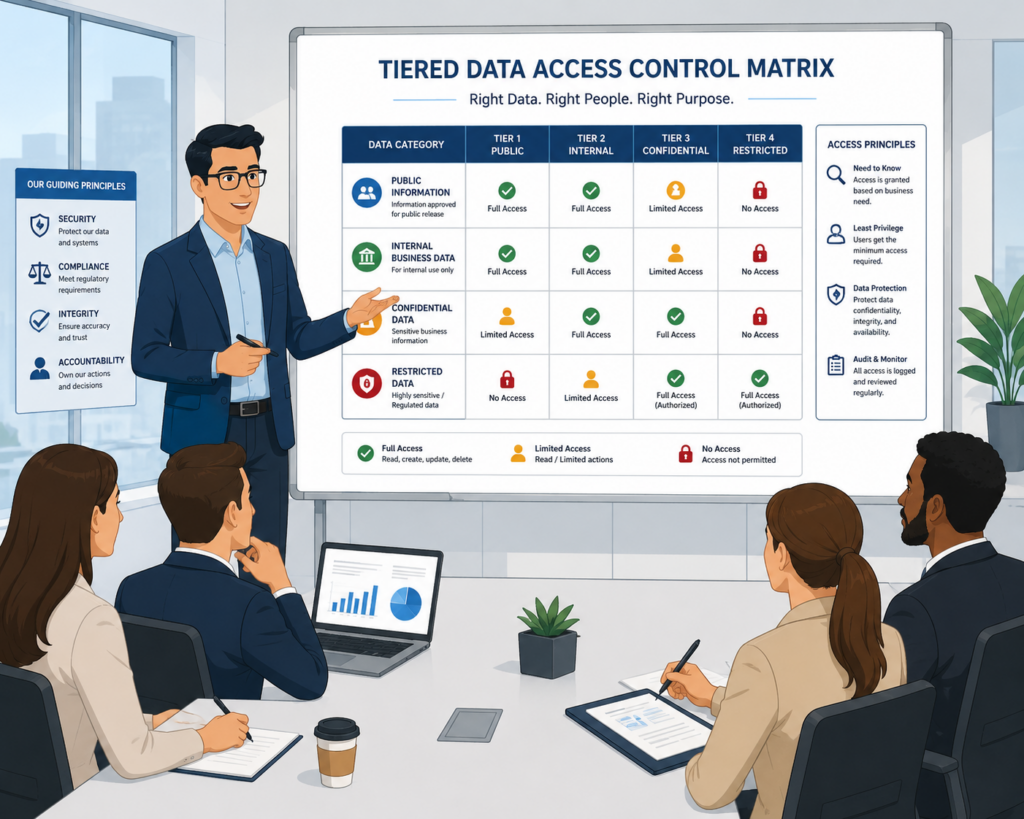
Step 3: Implement Tiered Access Control
Not every department needs access to every AI capability. Segment your permissions into defined tiers:
- Tier 1 (General Office Automation): Text summarization and email formatting using secure enterprise accounts (e.g., Microsoft 365 Copilot with commercial data protection).
- Tier 2 (Data Analytics): Restricted to qualified analysts using isolated, sandboxed environments to process anonymized data sets.
- Tier 3 (Development and Code Generation): Reserved for software engineers using managed environments like GitHub Copilot Enterprise with internal repository restrictions.
Security Goals
- Data Confidentiality: Encrypt sensitive data at-rest and in-transit; ensure only authorized entities can decrypt/use it.
- Data Integrity: Validate and sanitize all inputs (schema checks, content validation) to prevent injection of malformed or malicious data. Use checksums/hashes on stored data.
- Availability & Resilience: Architect for redundancy and failover (e.g. multi-AZ deployments, automatic scaling) so that security measures do not become single points of failure.
- Least Privilege & Access Control: Enforce strict RBAC or ABAC on all resources. Each service or user gets minimum permissions needed. Use centralized identity management (IAM, SSO/OIDC) with MFA.
- Auditability & Accountability: Log all access and significant events (data ingestion, ETL runs, admin actions) in a tamper-evident manner. Integrate with a SIEM for real-time analysis.
- Compliance: Meet applicable regulations through data protection measures (e.g. GDPR breach notification, HIPAA safeguards like encryption and audit logs). Ensure data residency and retention policies per law.
- Trustworthiness (Zero Trust): No implicit trust: authenticate and authorize every request (user and machine) regardless of network location. Employ micro segmentation via service mesh if possible.
LLMOps Pipeline Example and Data Flow
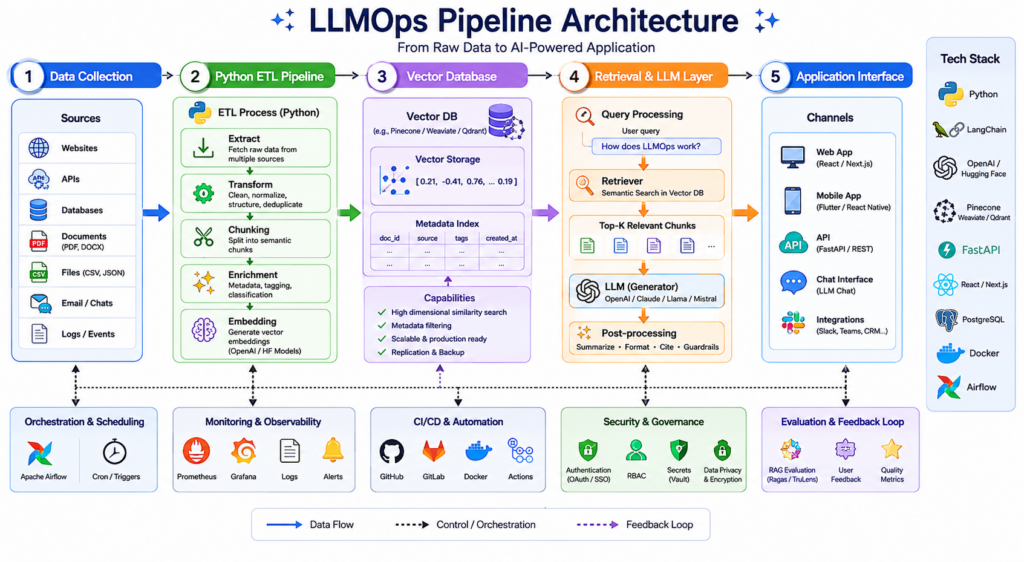
Below is a high-level data flow chart of a sample LLMOps pipeline. Raw and external data is ingested, processed by a Python-based ETL, stored in an encrypted vector database, and then served through a secured model API to end-user applications. Additional feedback loops (for retraining, monitoring) are included but omitted here for brevity.
mermaidCopygraph LR
    subgraph Ingestion
        A[Raw Data Sources<br/>(files, APIs)] -->|Fetch / Upload| B[Data Ingestion / ETL]
    end
    subgraph Storage
        B -->|Transform & Embed| C[Vector DB (Encrypted)]
    end
    subgraph Serving
        C -->|Retrieve Vectors| D[LLM Model & API<br/>(Fine-tuned LLM)]
    end
    subgraph Application
        D -->|API Responses| E[Client Application]
    end
    F[Monitoring / SIEM] --- B
    F --- D
    style F fill:#EFEFEF,stroke:#AAA,stroke-width:2px
Architecture Patterns
API Gateway: We place an API gateway (e.g. Kong, AWS API Gateway, or Apigee) at the ingress point. The gateway enforces TLS (HTTPS), authentication (OAuth2/OIDC token validation), and rate-limiting to mitigate abuse. It also centralizes metrics and logging for inbound/outbound API calls. By terminating connections at the gateway, downstream services can trust only pre-validated traffic.
Zero Trust (ZT): Following NIST SP 800-207, no internal network segment is inherently trusted. We implement mutual TLS (mTLS) between services (via a service mesh) and require authentication for every call. User/device identity and posture checks precede any access. For example, even if an attacker breaches one microservice, ZT design prevents lateral movement without going through additional auth checks.
Service Mesh: In containerized environments, a service mesh (e.g. Istio, Linkerd) provides mTLS encryption, service identity, and granular policies automatically between microservices. This simplifies rolling out Zero Trust by inserting sidecars that handle network-level security (TLS, retries, circuit-breaking, etc.) and expose metrics to the monitoring layer.
Event/Message Brokers: When asynchronous integration is needed (e.g. ingesting data from multiple sources), secure message brokers (Kafka, RabbitMQ) can be used. We ensure brokers are encrypted, authenticate producers/consumers, and apply topic-level ACLs.
Secure Service-to-Database Access: Database connections use TLS and credential policies. Use secrets management (below) to provide DB credentials.
Network Segmentation: We separate the pipeline into trust zones (e.g. DMZ for external ingestion, internal zone for processing, secure enclave for model training) even if virtual (VPCs, subnets). Firewalls or security groups restrict traffic flows tightly (e.g. only ETL nodes can access S3 buckets or vector DBs).
These patterns collectively create layers of defense. For instance, an example flow is: a client call enters the API Gateway → gateway authenticates and routes to the LLM service → the service mesh enforces mTLS to the vector DB → an auditing service records the event. Each hop enforces security.
Troubleshooting Guide: Mitigating Corporate Data Leaks
Problem
An employee accidentally uploads an unreleased product design or a sensitive client spreadsheet into a public AI chatbot interface.
Solution
- Revoke and Clear: Immediately access the specific account’s history settings and manually delete the chat conversation thread to remove it from immediate cache access.
- Contact Vendor Support: If the data is highly sensitive, immediately contact the AI vendor’s data protection officer to request a manual purge from backend logging databases.
- Deploy Enterprise Web Filtering: Update your corporate firewall policies to block consumer-grade AI URLs. Force traffic instead through managed corporate single-sign-on (SSO) entry points.
- Implement Data Loss Prevention (DLP): Configure your DLP software to recognize and automatically block strings matching PII or cryptographic keys from being pasted into external web browsers.
Solvable Frequently Asked Questions (FAQ)
Q1: How can I verify if an AI vendor actually protects my company data?
A: Request their SOC 2 Type II compliance report and review their Data Processing Addendum (DPA). Look for explicit clauses stating that your inputs are excluded from model training and that data is encrypted both in transit (TLS 1.3) and at rest (AES-256).
Q2: What is the most cost-effective way to get secure AI for a tiny team?
A: Avoid complex custom builds. Instead, purchase enterprise workspaces like Google Workspace Gemini Enterprise or ChatGPT Team. These entry-level tiers provide built-in commercial data privacy guarantees out of the box without requiring expensive programming.
Q3: How do we handle copyright ownership for content or code built by AI?
A: Standard legal practice indicates that purely AI-generated material cannot be copyrighted. To solve this liability, mandate a “Human-in-the-Loop” workflow. Every AI-assisted output must be substantially modified, edited, and verified by a human expert to secure clear intellectual property rights.

“AI enthusiast and Digital entrepreneur dedicated to helping others Leverage Technology for Financial Freedom”.
As an Amazon Associate, I earn from qualifying purchases.
`