
Introduction
The explosive growth of artificial intelligence has pushed enterprise computing infrastructure to its absolute limit. Running massive, complex neural networks requires immense computing power, forcing architects to make an architectural choice: Should processing happen in a centralized cloud datacenter, or directly on local devices at the edge of the network?
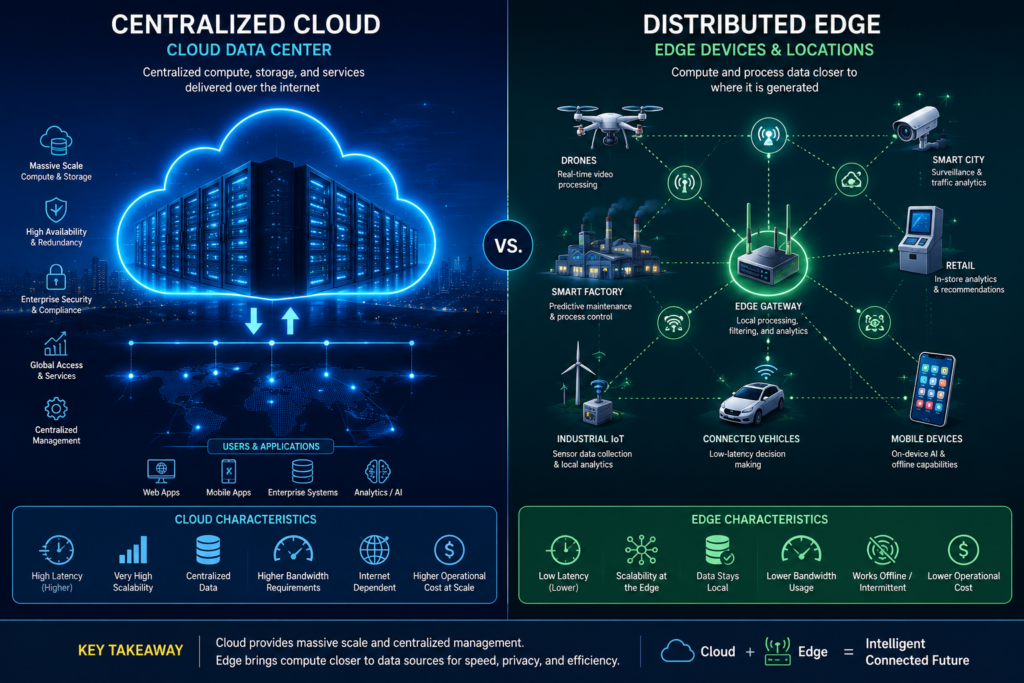
Here it is: Cloud datacenters are best for large-scale processing, model training, and centralized management due to their scalable compute resources, while edge processing is ideal for real-time inference, low latency, reduced bandwidth usage, and improved resilience at the point of data generation. In practice, most modern architectures use a hybrid approach where edge devices handle immediate processing and filtering, and the cloud performs training, orchestration, and deeper analytics to balance performance, cost efficiency, and scalability.
This training guide provides a deep comparative analysis of cloud versus edge computing for AI workloads. It offers a blueprint to help system architects deploy the optimal hybrid infrastructure for their specific organizational needs.
Detailed Architectural Matrix
| Metric / Feature | Centralized Cloud AI | Localized Edge AI |
|---|---|---|
| Compute Power | Virtually unlimited; access to thousands of clustered GPUs. | Constrained by local device hardware and thermal limits. |
| Network Latency | High (50ms–200ms+) depending on internet routing. | Ultra-low (1ms–10ms); processed directly on site. |
| Bandwidth Demands | Extreme; requires streaming raw data up to servers continuously. | Very low; sends only compressed operational metadata summaries. |
| Data Privacy | Higher risk; data travels across public infrastructure. | Maximum security; raw files never leave localized hardware. |
Deep-Dive Technical Comparison
Centralized Cloud AI: Scale and Power
Cloud AI relies on massive datacenters packed with high-end enterprise hardware. This approach is essential for training frontier models from scratch or running vast batch processing jobs across millions of data points.
However, cloud processing introduces a critical bottleneck: network latency. If an AI application must process live video streams to guide an automated forklift in a fast-moving factory, waiting for a round-trip cloud response can cause catastrophic physical accidents.
Localized Edge AI: Instantaneous Real-Time Processing
Edge AI shifts the processing directly onto local specialized chips called NPUs (Neural Processing Units) or compact embedded GPUs. Devices like smart security cameras, medical sensors, and autonomous vehicles process data locally, allowing them to make split-second decisions completely independent of an active internet connection.
The downside is hardware constraints. Edge devices cannot run giant models with hundreds of billions of parameters; they must use highly optimized, distilled model architectures.
Cloud AI Architecture:  [Edge Device]  =======(Internet Latency)======> [Central Cloud Data Center]
Edge AI Architecture:   [Edge Device + Internal NPU Processing] =====(Instant Action)=====> [Local Output]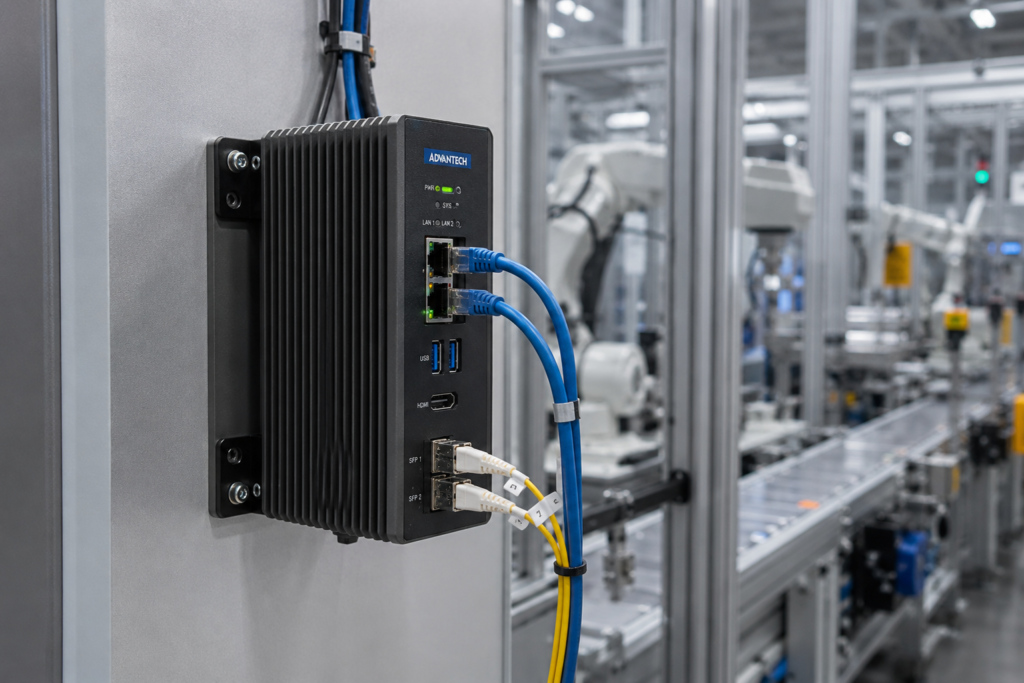
Troubleshooting Guide: Minimizing Network Bandwidth Strain
Problem
Your company deployed a high-definition AI camera system across 20 remote warehouses. The continuous uploading of video streams to cloud servers has completely saturated the company’s network bandwidth, crippling everyday office operations.
Solution
- Implement Frame-Rate Filtering: Modify the edge software layer to only capture and transmit video frames when its local motion sensors detect movement, dropping static video frames immediately.
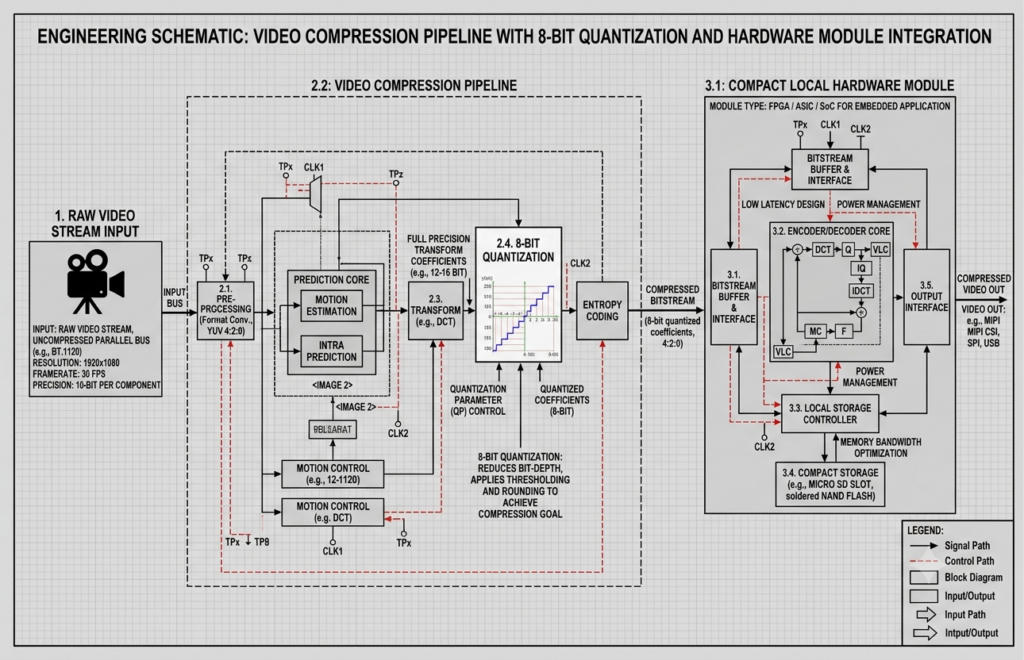
- Deploy Local Quantized Models: Flash a highly compressed, tiny object detection model directly onto the camera’s local onboard processor.
- Transition to Metadata Uploading: Configure the camera to process video locally and upload only lightweight text logs to the cloud (e.g.,
{"object": "person", "timestamp": "2026-05-30 20:00:00"}) instead of continuous, high-definition video files.
A: Use a hybrid model. Use Cloud AI for non-urgent, high-compute business tasks like reading quarterly financial reports or analyzing broad customer trends. Use Edge AI for real-time, on-site operational tasks like warehouse security scanning or localized manufacturing quality control.
Hybrid AI Architecture as the Industry Standard
In contemporary deployments, cloud computing and edge computing operate as complementary layers rather than competing alternatives. The cloud functions as the central intelligence hub responsible for large-scale model training, dataset aggregation, orchestration, and long-term analytics. It provides virtually unlimited scalability, enabling organizations to process massive datasets and iterate machine learning models efficiently.
In contrast, edge computing handles inference closer to the data source. This includes preprocessing, filtering, and executing lightweight AI models directly on local devices such as IoT sensors, industrial machines, mobile devices, or embedded systems. By minimizing reliance on constant cloud communication, edge systems significantly reduce latency and enhance operational resilience.
The interaction between these two layers forms a continuous feedback loop. Edge devices generate real-world data, which is periodically transmitted to the cloud for retraining and optimization. Updated models are then deployed back to edge nodes via over-the-air updates, ensuring continuous improvement of system intelligence.
Latency Engineering and Real-Time AI Constraints
Latency is one of the most critical factors influencing the cloud vs edge decision. Cloud-based systems inherently involve network round-trips, which introduce delays due to transmission distance, routing overhead, and congestion. While acceptable for batch processing and non-time-sensitive analytics, these delays become problematic in real-time applications.
Edge computing addresses this limitation by executing inference locally, often within milliseconds. This deterministic response time is essential in use cases such as autonomous vehicles, industrial automation, financial trading systems, and smart surveillance. In these environments, even minor delays can lead to degraded performance or operational risk.
From an engineering perspective, edge computing minimizes jitter and removes dependency on external network conditions, ensuring consistent and predictable response behavior. This makes it particularly suitable for mission-critical AI workloads.
Data Gravity and Bandwidth Economics
As organizations generate exponentially increasing volumes of data, the concept of data gravity becomes a central architectural constraint. Data tends to remain where it is generated because moving it across networks is expensive, slow, and inefficient.
High-bandwidth data sources such as video streams, telemetry systems, and sensor networks create significant strain on cloud ingestion pipelines. Transmitting raw data continuously to centralized datacenters results in bandwidth bottlenecks and escalating operational costs.
Edge computing mitigates this challenge by performing local filtering, compression, and preprocessing before any data is transmitted. Only relevant or summarized information is sent to the cloud. This dramatically reduces bandwidth consumption and improves system efficiency.
From a cost perspective, cloud-heavy architectures incur substantial data egress and transfer fees, while edge-based architectures shift processing closer to the source, optimizing network utilization and reducing dependency on expensive data movement.
Data Gravity and Bandwidth Economics
As organizations generate exponentially increasing volumes of data, the concept of data gravity becomes a central architectural constraint. Data tends to remain where it is generated because moving it across networks is expensive, slow, and inefficient.
High-bandwidth data sources such as video streams, telemetry systems, and sensor networks create significant strain on cloud ingestion pipelines. Transmitting raw data continuously to centralized datacenters results in bandwidth bottlenecks and escalating operational costs.
Edge computing mitigates this challenge by performing local filtering, compression, and preprocessing before any data is transmitted. Only relevant or summarized information is sent to the cloud. This dramatically reduces bandwidth consumption and improves system efficiency.
From a cost perspective, cloud-heavy architectures incur substantial data egress and transfer fees, while edge-based architectures shift processing closer to the source, optimizing network utilization and reducing dependency on expensive data movement.
Security, Privacy, and Regulatory Compliance
Security and data privacy considerations significantly influence architectural design in AI systems. Edge computing enhances privacy by ensuring that sensitive raw data, such as biometric information or video feeds, does not need to leave the local device. This reduces exposure risks and aligns with privacy-by-design principles.
However, distributed edge environments introduce new security challenges, including device-level vulnerabilities and physical tampering risks. Each edge node becomes a potential attack surface that must be secured individually.
Cloud computing, on the other hand, offers centralized security enforcement, advanced monitoring, and unified access control mechanisms. It simplifies governance and compliance reporting, particularly in regulated industries.
In practice, hybrid systems balance these trade-offs by keeping sensitive data localized while leveraging cloud infrastructure for secure aggregation, auditing, and policy management.
Solvable Frequently Asked Questions (FAQ)
Q1: What exactly is model quantization, and why does it matter for edge devices?
A: Model quantization is the process of converting the numerical weights of an AI model from high-precision formats (like 32-bit floating points) into lower-precision formats (like 8-bit integers). This shrinks the overall file size and compute requirements by over 70%, allowing complex models to run efficiently on small, low-power edge hardware.
Q2: Can edge AI devices function normally if the internet goes completely down?
A: Yes, that is a primary architectural benefit. Because the core AI model and specialized processing chips live inside the local hardware, edge devices can execute real-time analysis, trigger safety protocols, and log data without any active network connection.
Q3: How do you choose the right approach for a regular mid-sized business?
A: Use a hybrid model. Use Cloud AI for non-urgent, high-compute business tasks like reading quarterly financial reports or analyzing broad customer trends. Use Edge AI for real-time, on-site operational tasks like warehouse security scanning or localized manufacturing quality control.

“AI enthusiast and Digital entrepreneur dedicated to helping others Leverage Technology for Financial Freedom”.
As an Amazon Associate, I earn from qualifying purchases.
`